How to Calculate Elapsed Time Between Two Times
Elapsed time is the amount of time that passes between a starting time and an ending time. You can use it to calculate how long a meeting lasts, how many hours you work, how long a journey takes, or how much time passes between two activities.
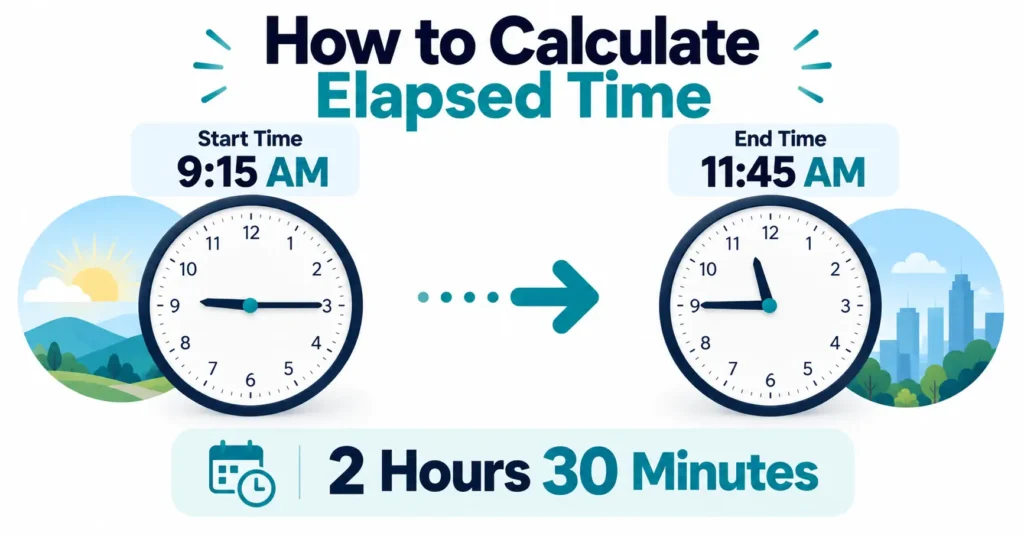
For example, if a meeting starts at 9:00 AM and ends at 11:30 AM, the elapsed time is 2 hours and 30 minutes.
The calculation is simple when you know the start and end times. However, it can become confusing when minutes are involved, the ending time is on the next day, or you need the answer in total minutes.
In this guide, you’ll learn how to calculate elapsed time using simple methods, formulas, and practical examples.
What Is Elapsed Time?
Elapsed time is the total duration between two points in time. It tells you how long something lasts, rather than the time shown on a clock.
For example:
- A class starts at 8:00 AM and ends at 9:00 AM. The elapsed time is 1 hour.
- A movie starts at 6:15 PM and ends at 8:45 PM. The elapsed time is 2 hours and 30 minutes.
- A journey starts at 10:30 PM and ends at 1:00 AM the next day. The elapsed time is 2 hours and 30 minutes.
Elapsed time can be measured in seconds, minutes, hours, or days, depending on the length of the period.
How to Calculate Elapsed Time Between Two Times
The easiest way to calculate elapsed time is to subtract the starting time from the ending time.
For example, if an activity begins at 10:00 AM and finishes at 2:00 PM, the calculation is:
2:00 PM − 10:00 AM = 4 hours.
Follow these steps to calculate elapsed time:
- Identify the starting time.
- Identify the ending time.
- Calculate the difference between the two times.
- Convert the result into hours and minutes if necessary.
Example 1: From 9:00 AM to 12:00 PM
Suppose you start studying at 9:00 AM and finish at noon.
| Time | Event |
|---|---|
| 9:00 AM | Start studying |
| 10:00 AM | 1 hour elapsed |
| 11:00 AM | 2 hours elapsed |
| 12:00 PM | 3 hours elapsed |
The total elapsed time is 3 hours.
Example 2: From 10:15 AM to 1:45 PM
Suppose a meeting begins at 10:15 AM and ends at 1:45 PM.
You can calculate the difference in two parts:
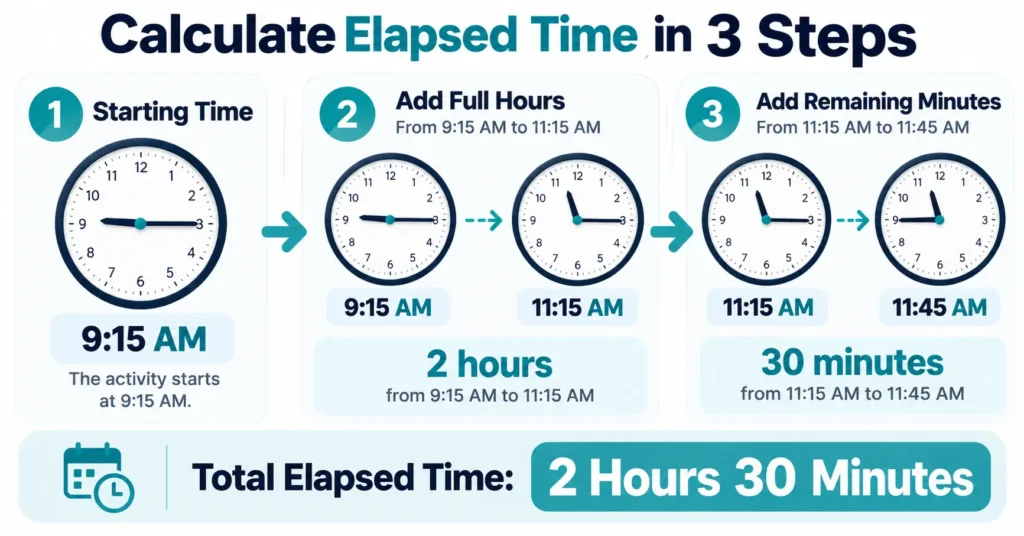
- 10:15 AM to 1:15 PM = 3 hours.
- 1:15 PM to 1:45 PM = 30 minutes.
The total elapsed time is 3 hours and 30 minutes.
This method works well when the starting and ending times include minutes.
How to Calculate Elapsed Time in Hours and Minutes
Sometimes, subtracting clock times directly can be confusing because minutes are counted from 00 to 59, not from 00 to 99.
For example, consider the time difference between 2:40 PM and 5:15 PM.
You cannot simply subtract 40 minutes from 15 minutes and write a negative number. Instead, borrow one hour from the ending time.
Step-by-step example
Starting time: 2:40 PM
Ending time: 5:15 PM
First, change 5:15 PM to 4 hours and 75 minutes for the purpose of subtraction.
| Part | Calculation | Result |
|---|---|---|
| Hours | 4 − 2 | 2 hours |
| Minutes | 75 − 40 | 35 minutes |
| Total | 2 hours 35 minutes |
The elapsed time between 2:40 PM and 5:15 PM is 2 hours and 35 minutes.
Remember that borrowing an hour adds 60 minutes to the ending time’s minute value while reducing its hour value by one.
How to Calculate Elapsed Time in Total Minutes
If you need the result in minutes, convert both times into minutes after midnight and subtract them.
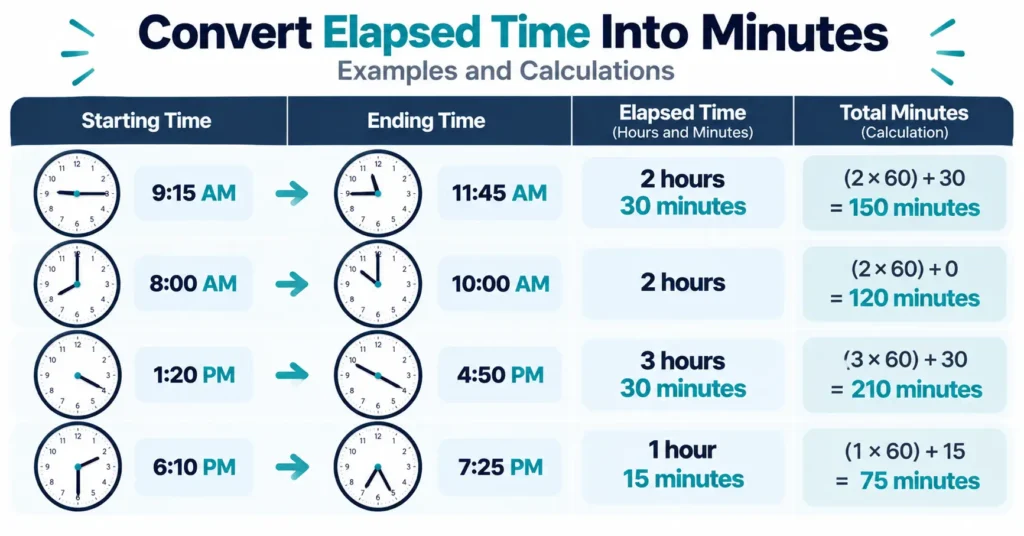
There are 60 minutes in an hour, so use this formula:
Total minutes = (Hours × 60) + Minutes
For example, let’s calculate the elapsed time from 9:20 AM to 11:50 AM.
Starting time:
(9 × 60) + 20 = 560 minutes.
Ending time:
(11 × 60) + 50 = 710 minutes.
Subtract the starting value from the ending value:
710 − 560 = 150 minutes.
Therefore, the elapsed time is 150 minutes, which equals 2 hours and 30 minutes.
This method is helpful when you need an answer in total minutes for work records, study sessions, exercise, or other activities.
Common Elapsed Time Examples
The following table shows common calculations between two times.
| Starting time | Ending time | Elapsed time |
|---|---|---|
| 8:00 AM | 10:00 AM | 2 hours |
| 9:15 AM | 11:45 AM | 2 hours 30 minutes |
| 12:30 PM | 3:00 PM | 2 hours 30 minutes |
| 1:20 PM | 4:50 PM | 3 hours 30 minutes |
| 6:10 PM | 7:25 PM | 1 hour 15 minutes |
| 8:45 AM | 9:10 AM | 25 minutes |
These examples cover both full-hour and partial-hour durations. The same calculation method applies whether the period lasts a few minutes or several hours.
How to Calculate Elapsed Time Across Midnight
When the ending time falls on the next day, you must account for the change of date.
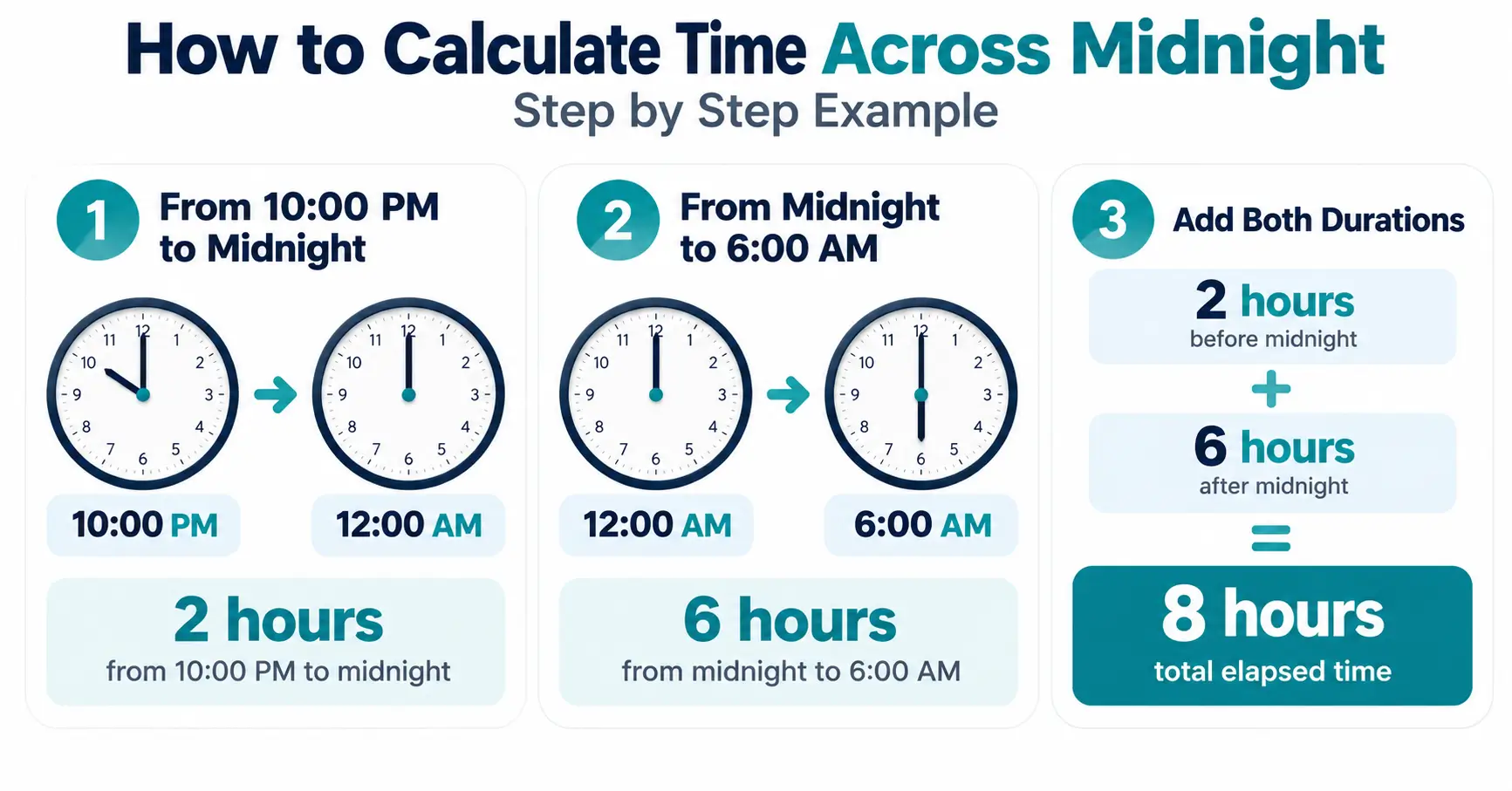
For example, suppose an activity starts at 10:00 PM and ends at 6:00 AM the following morning.
Calculate the duration in two parts:
- 10:00 PM to midnight = 2 hours.
- Midnight to 6:00 AM = 6 hours.
Total elapsed time:
2 + 6 = 8 hours.
If you need more examples and a detailed step-by-step explanation, read our guide to How to Calculate Time Across Midnight.
When you know the exact start and end dates, use the full date and time values to calculate the elapsed duration. This is especially important for events lasting more than one day.
How to Calculate Elapsed Time Using the 24-Hour Clock
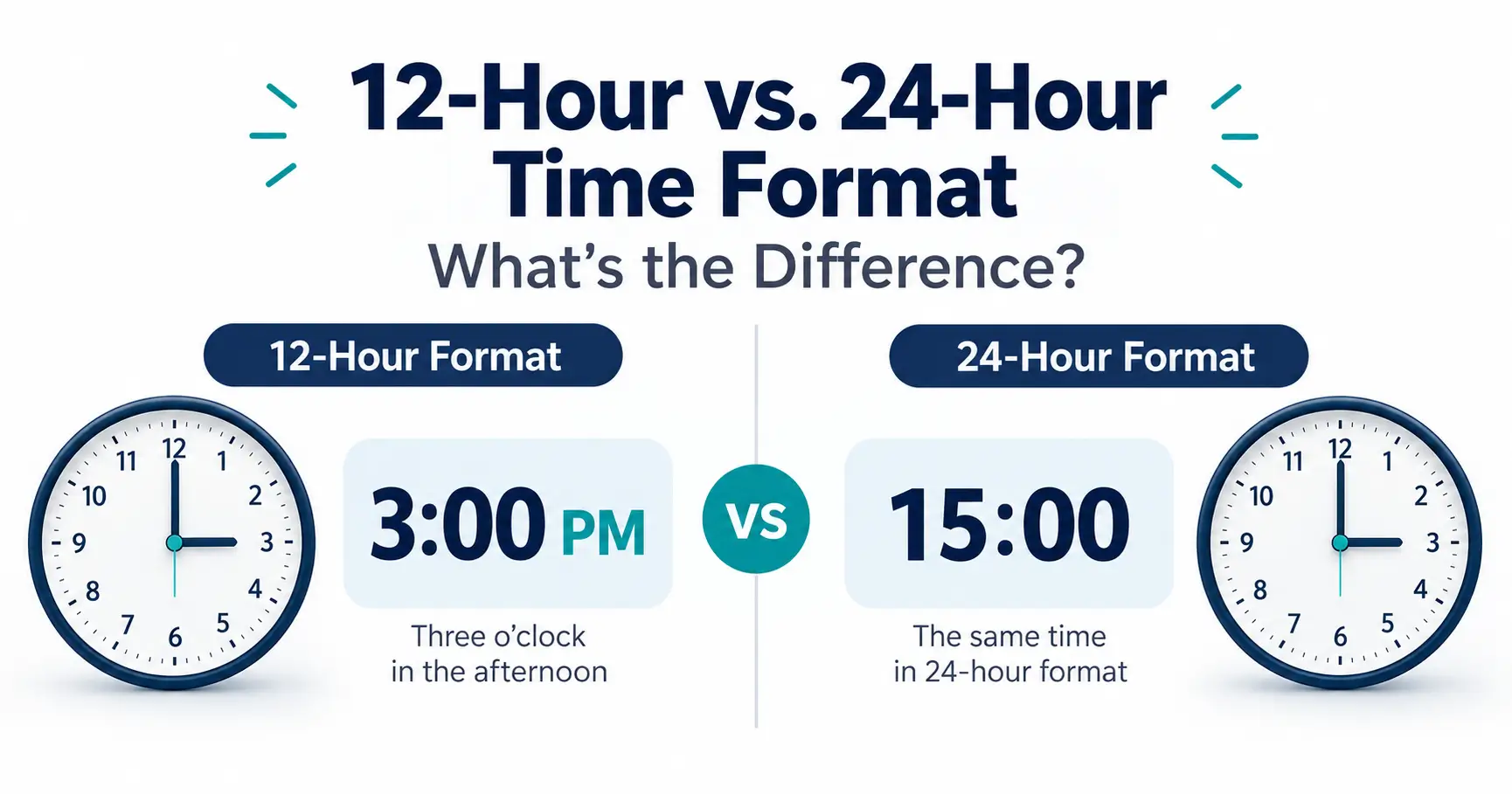
The 24-hour clock can make time calculations easier because it avoids the need to distinguish between AM and PM.
For example:
- 9:00 AM becomes 09:00.
- 2:30 PM becomes 14:30.
- 8:45 PM becomes 20:45.
Suppose you want to calculate the elapsed time from 13:20 to 17:50.
Subtract the starting time from the ending time:
17:50 − 13:20 = 4 hours and 30 minutes.
For times on the same day, this approach is straightforward. If the ending time belongs to the next day, include the date change in your calculation rather than subtracting the clock values alone.
How to Calculate Elapsed Time Quickly
You don’t always need to calculate the difference manually. For a quick answer, use our Hours From Now Calculator when you want to find a future time by adding hours, minutes, or seconds to the current time or a selected starting date and time.
For example, if you want to know what time it will be 5 hours and 30 minutes from a chosen starting point, enter the duration and calculate the result.
Keep in mind that adding a duration to a starting time is a forward-time calculation. Finding the elapsed time between two known times requires comparing the start and end points.
Common Mistakes When Calculating Elapsed Time
A few common errors can lead to incorrect results.
1. Mixing up AM and PM
9:00 AM and 9:00 PM are 12 hours apart. Always check whether each time is in the morning or evening.
2. Forgetting to account for minutes
The difference between 10:45 AM and 12:15 PM is 1 hour and 30 minutes, not 2 hours. Include the minutes in your calculation.
3. Ignoring the change of day
If an activity starts at 11:00 PM and ends at 2:00 AM the next day, the elapsed time is 3 hours, not a negative value.
4. Forgetting breaks
For a work shift, the time between clock-in and clock-out may include breaks. Subtract unpaid breaks if you need the actual working duration.
5. Using the wrong date
If the start and end times belong to different dates, use the full timestamps. This prevents errors when calculating overnight periods or durations longer than 24 hours.
Frequently Asked Questions
What is the formula for elapsed time?
The basic formula is:
Elapsed time = Ending time − Starting time
For times that cross midnight, account for the next day. If you have complete date and time values, subtract the starting timestamp from the ending timestamp.
How do you calculate elapsed time between 9 AM and 5 PM?
From 9:00 AM to 5:00 PM is 8 hours.
How do you calculate elapsed time between 2:30 PM and 4:15 PM?
From 2:30 PM to 4:00 PM is 1 hour and 30 minutes. From 4:00 PM to 4:15 PM is another 15 minutes. The total is 1 hour and 45 minutes.
How do you convert elapsed time into minutes?
Multiply the number of hours by 60, then add the remaining minutes.
For example, 3 hours and 20 minutes equals (3 × 60) + 20 = 200 minutes.
Can elapsed time be longer than 24 hours?
Yes. If an event lasts several days, calculate the difference using the complete starting and ending dates and times. For example, a period from Monday at 10:00 AM to Tuesday at 10:00 AM lasts 24 hours.
Is elapsed time the same as time of day?
No. Time of day tells you the current clock reading, such as 3:00 PM. Elapsed time tells you how much time has passed between two points, such as 2 hours and 30 minutes.
Final Thoughts
Calculating elapsed time is easier when you identify the starting and ending times, subtract them carefully, and account for minutes and date changes when needed.
You can use these methods to calculate meeting durations, work hours, travel times, study sessions, and many other everyday activities. For overnight calculations, remember to account for midnight and the next calendar day.
If you need to calculate a future time from a selected starting point, try our Hours From Now Calculator for a quick result.