12-Hour vs. 24-Hour Time: Key Differences Explained
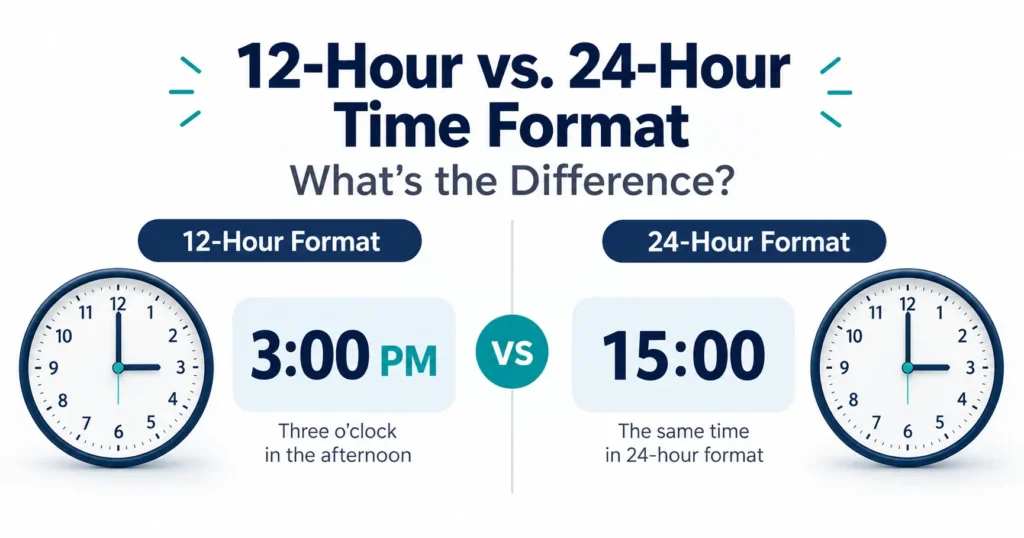
12-Hour vs. 24-Hour Time Format: What’s the Difference?
Time can be written in two common formats: the 12-hour clock and the 24-hour clock. Both formats show the same time of day, but they display hours differently.
For example, 3:00 PM in the 12-hour format is written as 15:00 in the 24-hour format. The main difference is that the 12-hour clock uses AM and PM to distinguish morning from afternoon and evening, while the 24-hour clock uses numbers from 00 to 23.
Understanding the difference between these formats can help you read schedules, plan activities, set alarms, and avoid confusion when working with times. If you need to find a future time quickly, use our Hours From Now Calculator. In this guide, you’ll learn how both formats work, what AM and PM mean, and how to convert times from one format to the other.
What Is the 12-Hour Time Format?
The 12-hour time format divides a day into two periods of 12 hours each. It uses the numbers 1 through 12, along with AM or PM, to show whether a time falls before or after noon.
The two periods are:
- AM: From midnight until just before noon.
- PM: From noon until just before midnight.
Each period contains 12 hours, making a total of 24 hours in a full day.
Here are some examples of the 12-hour format:
| Time | Meaning |
|---|---|
| 7:00 AM | Seven o’clock in the morning |
| 10:30 AM | Half past ten in the morning |
| 12:00 PM | Noon |
| 3:00 PM | Three o’clock in the afternoon |
| 6:00 PM | Six o’clock in the evening |
| 11:00 PM | Eleven o’clock at night |
The 12-hour format is common in everyday conversation and is widely used in countries such as the United States. However, its use varies by country, industry, and personal preference.
One important detail is that the 12-hour clock uses the number 12 at both midnight and noon. You must use AM or PM to tell these times apart.
What Is the 24-Hour Time Format?
The 24-hour time format counts the hours of a day from 00 to 23. It does not need AM or PM because every hour has its own number.
The day begins at 00:00 at midnight and continues through 23:59, the final minute before the next midnight.
For example:
| 24-Hour Time | 12-Hour Time |
|---|---|
| 00:00 | 12:00 AM (midnight) |
| 06:00 | 6:00 AM |
| 09:30 | 9:30 AM |
| 12:00 | 12:00 PM (noon) |
| 15:00 | 3:00 PM |
| 18:00 | 6:00 PM |
| 21:00 | 9:00 PM |
| 23:00 | 11:00 PM |
The 24-hour format is frequently used in transport timetables, travel schedules, healthcare settings, and other situations where clear time notation is important.
For example, a train departure listed as 18:45 means 6:45 PM. There is no need to determine whether the time is in the morning or evening because the hour number makes it clear.
The 24-hour format is also useful when calculating time intervals, particularly when an activity starts in the evening and ends after midnight.
12-Hour vs. 24-Hour Time: Key Differences
Both formats represent the same 24-hour day. The difference is how the hours are numbered and how the time of day is communicated.
| Feature | 12-Hour Format | 24-Hour Format |
|---|---|---|
| Hour numbers | 1 through 12 | 00 through 23 |
| AM and PM | Required to distinguish the two halves of the day | Not required |
| Morning example | 9:00 AM | 09:00 |
| Evening example | 9:00 PM | 21:00 |
| Midnight | 12:00 AM | 00:00 |
| Noon | 12:00 PM | 12:00 |
| Common use | Everyday conversation and many clock displays | Schedules, timetables, and precise time records |
Which Format Is Easier to Read?
The answer depends on what you are used to.
People who regularly use the 12-hour format may find times such as 8:00 AM and 8:00 PM easy to understand. Others may prefer 08:00 and 20:00 because the hour number clearly identifies the time of day.
The 24-hour format can reduce confusion when reading schedules, especially when both morning and evening events appear together.
For example, a schedule showing 08:00, 14:00, and 20:00 makes it clear that the events take place in the morning, afternoon, and evening.
Neither format is universally better. The best choice depends on your needs, your local conventions, and the format used by the device or service you are working with.
What Do AM and PM Mean?
AM and PM are abbreviations used with the 12-hour clock.
AM stands for the Latin phrase ante meridiem, which means “before midday.” It covers the time from midnight up to, but not including, noon.
PM stands for post meridiem, which means “after midday.” It covers the time from noon up to, but not including, the next midnight.
Here is a simple guide:
| Time Period | Examples |
|---|---|
| Early morning | 5:00 AM, 6:00 AM |
| Late morning | 10:00 AM, 11:00 AM |
| Noon | 12:00 PM |
| Afternoon | 1:00 PM, 3:00 PM |
| Evening | 6:00 PM, 8:00 PM |
| Late night | 10:00 PM, 11:00 PM |
| Midnight | 12:00 AM |
Remember that AM does not mean “morning” in every everyday context. The period begins at midnight, so 12:30 AM is half an hour after midnight.
Similarly, 12:30 PM is half an hour after noon.
Understanding these details makes it easier to read appointments, set reminders, and interpret times correctly.
12 AM vs. 12 PM: What’s the Difference?
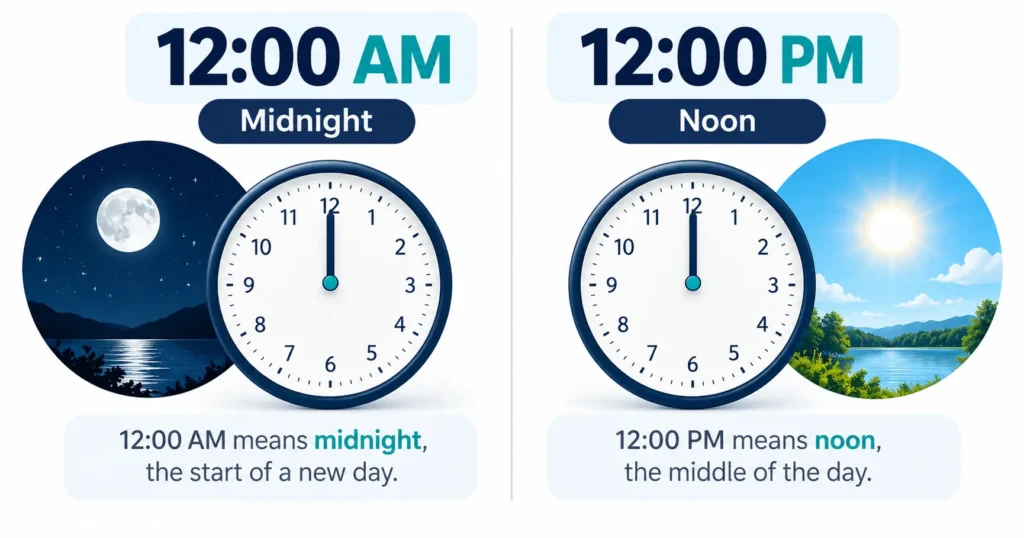
The difference between 12 AM and 12 PM is one of the most common sources of confusion when using the 12-hour clock.
- 12:00 AM means midnight, when one calendar day ends and the next begins.
- 12:00 PM means noon, the middle of the day.
For example, if an event begins on Monday at 12:00 AM, it starts at the very beginning of Monday. If it begins on Monday at 12:00 PM, it starts at midday on Monday.
The same distinction applies to other times around these points:
- 12:01 AM is one minute after midnight.
- 11:59 AM is one minute before noon.
- 12:01 PM is one minute after noon.
- 11:59 PM is one minute before midnight.
When clarity is especially important, consider writing “midnight” or “noon” instead of using 12 AM or 12 PM. This can help prevent misunderstandings when scheduling flights, appointments, deadlines, or other time-sensitive activities.
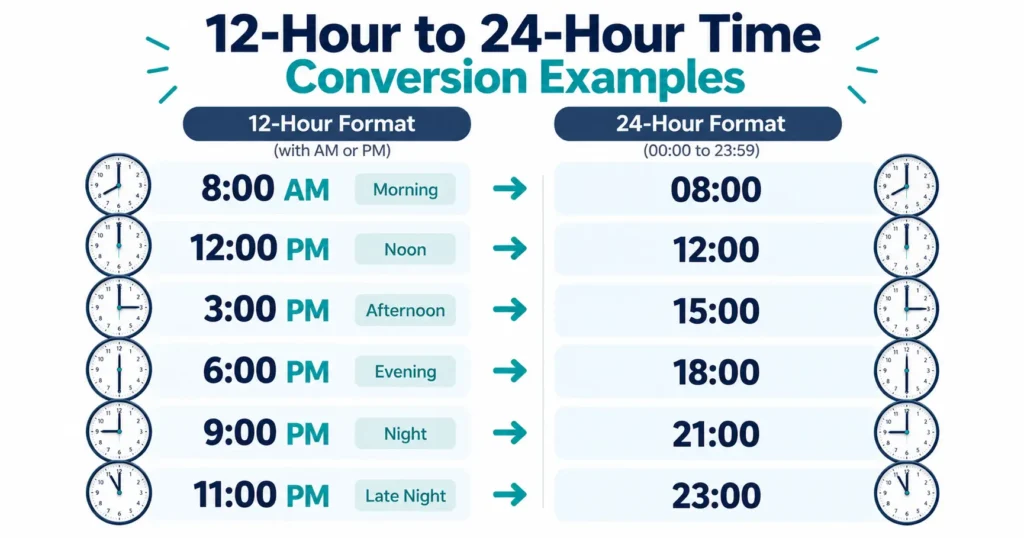
How to Convert 12-Hour Time to 24-Hour Time
Converting from the 12-hour format to the 24-hour format is straightforward once you know the rules.
For AM Times
For times from 1:00 AM through 11:59 AM, keep the hour number the same. If the hour is a single digit, add a leading zero in the 24-hour format.
Examples:
- 6:15 AM → 06:15
- 8:30 AM → 08:30
- 10:45 AM → 10:45
- 11:50 AM → 11:50
The exception is 12:00 AM, which becomes 00:00.
For PM Times
For times from 1:00 PM through 11:59 PM, add 12 to the hour number.
Examples:
- 1:30 PM → 13:30
- 3:45 PM → 15:45
- 6:20 PM → 18:20
- 9:10 PM → 21:10
- 11:30 PM → 23:30
The exception is 12:00 PM, which stays 12:00 in the 24-hour format.
Quick Conversion Rules
| 12-Hour Time | 24-Hour Time |
|---|---|
| 12:00 AM | 00:00 |
| 1:00 AM | 01:00 |
| 8:00 AM | 08:00 |
| 11:00 AM | 11:00 |
| 12:00 PM | 12:00 |
| 1:00 PM | 13:00 |
| 4:00 PM | 16:00 |
| 7:00 PM | 19:00 |
| 10:00 PM | 22:00 |
| 11:00 PM | 23:00 |
Tip: For PM times after noon, add 12 to the hour, except when the hour is 12. For AM times before noon, keep the hour the same, except when the hour is 12.
How to Convert 24-Hour Time to 12-Hour Time
To convert from the 24-hour format to the 12-hour format, look at the hour number.
For Hours From 00 to 11
Times from 00:00 through 11:59 are in the AM period.
- 00:30 → 12:30 AM
- 05:15 → 5:15 AM
- 07:45 → 7:45 AM
- 11:30 → 11:30 AM
Remember that 00 represents 12 AM, not 0 AM.
For Hours From 12 to 23
Times from 12:00 through 12:59 remain in the PM period and keep the hour number 12.
For hours from 13 through 23, subtract 12 from the hour and use PM.
Examples:
- 12:15 → 12:15 PM
- 13:30 → 1:30 PM
- 16:45 → 4:45 PM
- 19:20 → 7:20 PM
- 22:10 → 10:10 PM
- 23:50 → 11:50 PM
These rules work for any valid time in the 24-hour format.
12-Hour and 24-Hour Time Conversion Chart
Use this chart as a quick reference for common times throughout the day.
| 12-Hour Time | 24-Hour Time |
|---|---|
| 12:00 AM (midnight) | 00:00 |
| 1:00 AM | 01:00 |
| 2:00 AM | 02:00 |
| 3:00 AM | 03:00 |
| 4:00 AM | 04:00 |
| 5:00 AM | 05:00 |
| 6:00 AM | 06:00 |
| 7:00 AM | 07:00 |
| 8:00 AM | 08:00 |
| 9:00 AM | 09:00 |
| 10:00 AM | 10:00 |
| 11:00 AM | 11:00 |
| 12:00 PM (noon) | 12:00 |
| 1:00 PM | 13:00 |
| 2:00 PM | 14:00 |
| 3:00 PM | 15:00 |
| 4:00 PM | 16:00 |
| 5:00 PM | 17:00 |
| 6:00 PM | 18:00 |
| 7:00 PM | 19:00 |
| 8:00 PM | 20:00 |
| 9:00 PM | 21:00 |
| 10:00 PM | 22:00 |
| 11:00 PM | 23:00 |
This chart covers every whole hour of the day. For times that include minutes, use the same conversion rules while keeping the minutes unchanged.
For example, 4:35 PM becomes 16:35, and 07:20 becomes 7:20 AM.
Which Time Format Should You Use?
Both time formats are correct, so the choice usually depends on the situation.
When to Use the 12-Hour Format
The 12-hour format can be convenient for everyday conversation, personal schedules, and informal plans, particularly in places where AM and PM are commonly used.
For example, saying “Let’s meet at 6:00 PM” may feel more natural to people who use the 12-hour clock regularly.
When to Use the 24-Hour Format
The 24-hour format is useful when you need to communicate times clearly without AM or PM.
It is commonly used in transport timetables, travel schedules, healthcare settings, and other environments where confusing morning and evening times could cause problems.
For example, 06:00 and 18:00 clearly represent different times, while 6:00 requires AM or PM to communicate the same distinction.
What About Phones and Computers?
Many phones, computers, digital watches, and other devices let you choose between 12-hour and 24-hour time.
The setting may be called “24-hour time,” “Use 24-hour format,” or something similar. The exact option depends on your device and operating system.
Changing the setting usually affects how the time is displayed, not the actual time or the device’s time zone.
Frequently Asked Questions
Is 12-hour or 24-hour time better?
Neither format is universally better. The 12-hour format uses AM and PM and is familiar to many people, while the 24-hour format makes the time of day clear without additional labels. Choose the format that suits your needs and local conventions.
Is 12 AM midnight or noon?
12 AM means midnight, the start of a new calendar day. For example, Monday at 12:00 AM is the beginning of Monday.
Is 12 PM midnight or noon?
12 PM means noon, the middle of the day. For example, 12:00 PM is midday, not midnight.
What is 18:00 in 12-hour time?
18:00 in the 24-hour format is 6:00 PM in the 12-hour format. Subtract 12 from 18 to get 6, then use PM.
What is 12:00 AM in 24-hour time?
12:00 AM is written as 00:00 in the 24-hour format. Both represent midnight.
Why do some schedules use 24-hour time?
The 24-hour format removes the need for AM and PM. This makes it useful for schedules, timetables, and time records where clear communication is important.
Can I switch between 12-hour and 24-hour time on my device?
Yes. Many smartphones, computers, and digital devices let you change the time display in their settings. Look for a clock or date-and-time setting and select your preferred format.
Does changing the time format change the actual time?
No. Changing between 12-hour and 24-hour display formats changes how the time appears, not the actual time. For example, 7:00 PM and 19:00 represent the same moment.
Conclusion
The main difference between 12-hour and 24-hour time is how they display the hours of a day. The 12-hour format uses AM and PM, while the 24-hour format counts from 00:00 to 23:59.
Remember these two important rules: 12 AM means midnight, and 12 PM means noon. For converting times, keep AM hours the same except for midnight, and add 12 to PM hours except for noon.
Once you understand these rules, switching between the two formats becomes easy. If you need to calculate a future or past time for planning, appointments, or daily activities, explore our time calculators to find the result you need.